Showing posts with label science. Show all posts

Tuesday, April 9, 2013

Imagine the possibilities if we could only read your mind…or at least map your brain


"Imagine if no family had to feel helpless watching a loved one disappear behind the mask of Parkinson’s or struggle in the grip of epilepsy.  Imagine if we could reverse traumatic brain injury or PTSD for our veterans who are coming home…,” said President Barack Obama last week as he laid a grand, ambitious new government initiative to map the brain.

Obama said he will ask Congress for $100 million in 2014 to support the BRAIN (Brain Research through Advancing Innovative Neurotechnologies) initiative which allows us to "better understand how we think and how we learn and how we remember." Three government agencies will be involved: the National Institutes of Health, the Defense Advanced Research Projects Agency and the National Science Foundation.

“It's an audacious, bold idea,” said Francis  Collins, director of the NIH. "To understand how the human brain works is about the most audacious scientific project you can imagine," he said. "It's the most complicated structure in the known universe."

In many ways, this initiative is similar to the Human Genome Project which Collins led and completed in 2003, in its vision and ambition. But, unlike the Human Genome Project, the BRAIN initiative has not laid out its primary scientific goals. The lack of detail is worrying BRAIN skeptics and advocates alike. Some scientists were quick to question the motives behind this initiative, noting that a lot of great research on the brain is already underway.”

At a Q&A segment  following the President’s announcement, Collins said that these details would be hammered out by a “dream team” of 15 scientists who will hold their first meeting at the end of the month. This team is led by Cori Bargmann of Rockefeller University and William Newsome of Stanford University, will be charged with coming up with a plan, a time frame, specific goals and cost estimates for future budgets.

Additionally, Obama addressed how this initiative can drive growth and create new job opportunities. As the “rest of the world” is racing ahead in the quest for innovation, he expressed concern that we will lose a new generation of scientists because of uncertainty in research funding. We can’t afford to miss these opportunities, he said.

The President called on companies, research universities, foundations, and philanthropists to get involved.

What we took from sitting in the room with the leaders and innovators in science and research as the president spoke about the promise and potential of this new initiative, was a broader message about the power and value of investing in science, and the important role the federal government plays in ensuring scientific breakthroughs can improve health.  We took such enthusiasm and energy as our cue to be more determined than ever to advance medical progress.

Upcoming Milestones
  • As part of this planning process, input will be sought broadly from the scientific community, patient advocates, and the general public.
  • The working group will be asked to produce an interim report by fall 2013 that will contain specific recommendations on high priority  investments for Fiscal Year (FY) 2014.
  • The final report will be delivered to the NIH Director in June 2014.


Key Resources:


Tuesday, February 26, 2013

The IOM wants to know how you feel about CTSAs (say what?)

By Kristin Schneeman, Program Director, FasterCures

Have you ever heard of a CTSA?  How about NCATS?  Does this feel a little like a word game – how many acronyms can you make out of these letters?

CTSAs are Clinical and Translational Science Awards, a significant program at the National Institutes of Health to fund – you guessed it – translational and clinical science and resources (as distinct from the more basic discovery science NIH has historically supported) at the nation’s most prominent academic research institutions, 60 in all, across the entire country. NCATS is the National Center for Advancing Translational Science, the newest Center at NIH which was created to “catalyze the generation of innovative methods and technologies” to support the translation of promising basic discoveries into new diagnostics and therapeutics for patients.

Last fall, NCATS asked the Institute of Medicine to conduct a review of the CTSA program, which at $461 million is the largest component of NCATS’ $575 million budget and its assets. I attended the most recent committee meeting at the end of January, which focused to a significant degree on the CTSAs’ “community engagement.” There was not much clarity about what “communities” were supposed to be engaged – in most cases they seem to be the geographic communities in which the CTSAs are located, but in some cases they seem to be the patient communities that researchers are interested in studying, which may or may not be local. Community engagement activities and research were in previous years required components of CTSA applications but are no longer; that was the source of some consternation at the meeting, with speakers lamenting that relationships painstakingly built over the course of the first five plus years of the program were at risk (and that new ones would not be a priority) if they aren’t a requirement of funding. Among the most eloquent speakers was Bray Patrick-Lake of the Clinical Trials Transformation Initiative, herself a patient advocate, who said trust and relationship-building are long-term endeavors, and that academic institutions need to invest in patient groups and “not just come running when you need them for a grant.”

Also notable at this meeting was the lack of focus on what might be done with the CTSAs as a network, as opposed to how the individual institutions are progressing and evolving. This does seem to have been taken up at previous IOM meetings as part of this review, but it was markedly absent during the discussions about future directions for the program that wrapped up this particular day. NCATS itself has made a principle for the next stage of the program that “the whole must be greater than the sum of its parts,” and many observers believe that great things could be achieved by connecting all these major institutions and allowing stakeholders both internal and external to better understand and access the expertise and resources that reside in them. There is a relatively new Coordinating Center which has begun working on developing shared resources such as IRBshare, Contractshare, and the Research Electronic Data Capture (REDCap) platform, which could benefit external stakeholders as well as the CTSAs themselves.

The IOM is accepting comments from the public about the CTSAs until March 1st.  We encourage you to take a look at the questions and to consider commenting.  Even if you aren’t familiar with the CTSAs, that might be worthy of comment in and of itself. Here are a few of the questions we’re focused on:
  • Are potential stakeholders aware of the resources available through the CTSA Program and are there barriers to use of those resources?
  • Have the CTSA institutions, individually and collectively, played an appropriate and adequate role in involving and interacting with community organizations and patient advocacy groups? 
  • Does the balance of CTSA Program efforts across the continuum of research from first phase studies in humans to clinical trials to population-based research on health outcomes and comparative effectiveness need to shift?
  • What do you see as successes, challenges, and future directions of the CTSA Program?

Friday, February 22, 2013

Time=Lives Story of the Week: Michael Kaplan


“I’ve been a Type 1 diabetic since I was 12, so 31 years; and HIV positive for 20 years this March. I’ve been able to maintain good health, keep my viral load down, my t-cells up, which has allowed me to do the work I do.” – Michael Kaplan, President & CEO of AIDS United

It has been over thirty years since the emergence of the HIV/AIDS epidemic and thanks to incredible advancements in science, a diagnosis once tantamount to a death sentence is today managed in much the same way as a chronic disease. Great strides have been made in reducing the burden of HIV/AIDS, but this is a war still in progress.

A leading advocate for HIV/AIDS patients, policy, and research, Michael Kaplan is the president and CEO of AIDS United.  Born out of the merger of the National AIDS Fund and AIDS Action in late 2010, AIDS United’s mission is to end the AIDS epidemic in the United States by combining strategic grantmaking and capacity-building with national advocacy to ensure access to life-saving HIV/AIDS therapies and services, and advance key policy initiatives.


“As the successes of early treatment towards prevention merge with health care reform across the U.S.,” says Kaplan” the light at the end of the tunnel is only getting brighter.  I truly believe I’ll see the end of this epidemic in my lifetime."

Kaplan advocates for early testing and treatment as a way to dramatically decrease the number of new HIV/AIDS cases and help those already infected to start managing their illness as soon as possible. Like many currently incurable diseases, access to treatment is crucial. NIH research shows that the right drug cocktail can reduce a person’s ability to spread the virus to another by up to 96 percent.

Medical research discoveries from several fields have helped create many of the current medications HIV/AIDS patients depends upon today. Just as in the past, “fundamental basic research that is being done now is going to lead to things ten or fifteen years from now that we cannot predict,” said Dr. Anthony Fauci at a FasterCures' 2012 Celebration of Science event.

But with funding for research across all diseases at risk because of sequestration – looming, across-the-board budget cuts – support for the work of advocates like Michael and the science he helps to advance is more important than ever. Saving time in medical research means saving lives.  

See more stories about the power and promise of medical research, and tell us why medical research matters to you.

-- VISIT the campaign Web site
-- LIKE the Facebook page
-- TWEET with us at #TimeEqLives
-- DOWNLOAD and SHARE the Message
-- TELL us your story


Relevant Links:
-- Back to Basics: HIV/AIDS Advocacy as a Model for Catalyzing Change


Wednesday, February 13, 2013

Medical research delivers cures, saves lives and – oh, by the way – is pretty great for our economy too


Over the past few weeks, Washington D.C. has been abuzz with conversation about the value of medical research to our national economy, collective health, and global competitiveness. Leading up to our own Capitol Hill briefing with Friends of Cancer Research last Wednesday – “The Blueprint of Medical Research: How New Medicines Get from the Lab to the Patient” – FasterCures has attended several events focused on the impact of research and research funding on our nation’s well-being.

We’ve heard unequivocally that scientific opportunity – particularly when it comes to our understanding of disease biology – has never been greater, but the outlook for funding has also never been more worrisome.  If we don’t increase our investment in medical research, we’re effectively cutting it, risking not only a major engine that fuels our economy, but also the lives of hundreds of thousands of people living with diseases that have few or no meaningful treatment options.

The budgetary decisions we make today are decisions that won’t just have an impact in our lifetimes, but will alter the course of the next generation of patients, family members, and young scientists.  Here are some of the things we’ve heard around town: 
  • “If scientists can take a few minutes to put down their microscopes and pick up a microphone it will make a real difference.  As we stand at this budget crossroads, we need your help to make the case.”
    • Congressman Ed Markey (D-MA) at American Cancer Society’s Cancer Action Network briefing on Capitol Hill, February 5, 2013
  • “The FDA is really a bargain when you look at scope of activities that have exploded without parallel budget increases. FDA costs only about $8 per American per year, and we are determined to maximize the dollars that we have. Drugs are available in the U.S. faster than anywhere else in the world, and with 39 new approvals in 2012, including a number of new advances in personalized medicine, we are making real progress. Sequestration would result in a significant reduction of domestic and international inspections, which makes for a tough environment in which to recruit and retain top people. We cannot walk away from our responsibilities."
  • The average per capita National Institutes of Health investment is just under $100/citizen/year, and less than 1% of federal budget. Yet these investments are having an outsized impact on our economy and health. The more stories that scientists and patients can tell in their own words, the more likely it is that the message will resonate with our policymakers. 
  • “We have come so far in cancer science, especially in my field of immunotherapy. We now live in an age where it is possible to take the army in own bodies, and train it to fight against our particular disease. But scientists like me would not be where we are if not for the investments that were made in us at the start of our careers.  If the budget of the NIH is cut any further we will be faced with having to tell the patients who rely on our science: I’m sorry, there’s nothing more we can do.  No one wants to be the giver or receiver of this heartbreaking message.”
    • Helen Sabzevari, global head of oncology-immunotherapy for EMD Serono Inc. at American Cancer Society’s Cancer Action Network briefing on Capitol Hill, February 5, 2013
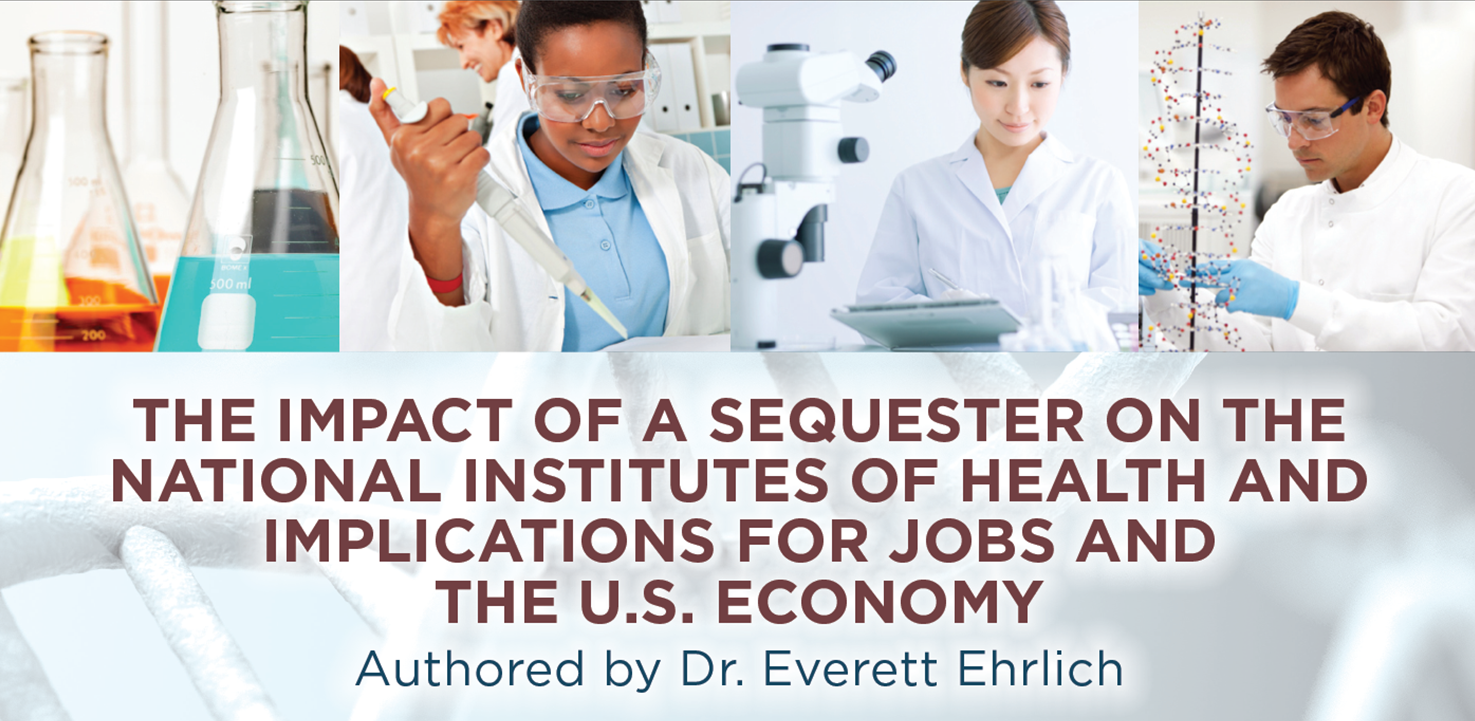
  • "The National Institutes of Health (NIH) supported more than 402,000 jobs and $57.8 billion in economic output nationwide in 2012 alone. If Congress fails to prevent the 5.1 percent automatic, across-the-board spending cuts slated for March 1, the nation's life sciences sector could lose 20,500 jobs and $3 billion in economic input."
Currently, only five cents of every U.S. health dollar goes to biomedical research; however, 1 in every 3 Americans is living with a deadly or debilitating disease for which there are no cures. The U.S. needs strong investment in biomedical research to deliver cures, save lives, and maintain our global competitiveness. There’s no time to waste.

Relevant links:
-- ACS CAN Report Highlights Critical Need for Sustained Funding for Cancer Research
-- Videocast of Jan. 14 SMRB meeting
-- The State of the FDA—February 2013
-- Report from United for Medical Research about the Economic Impact of Sequester on Life Sciences Sector
-- Sequestration Station
-- Time=Lives

Friday, February 8, 2013

Time=Lives Story of the Week: Andrew Goldstein


“The day that science doesn't get me up in the morning and make me love these questions, it’s not right for me. But, until then, I just keep doing it and keep going for the questions we don’t have answers to.”

Meet Andrew Goldstein. Like many young investigators, the prospect of new discovery and hope to transform lives and cure disease keeps him excited about science and the possibilities it can open up. In addition to being an ex pro lacrosse player, Andrew is also an assistant researcher at Jonsson Comprehensive Cancer Center at UCLA, where he focuses on developing new scientific approaches to tackling advanced prostate cancer. 


In 2010, Andrew was part of a team of scientists who identified for the first time a cell-of-origin for human prostate cancer, a discovery that could result in better predictive and diagnostics tools and the development of more effective targeted treatments for the disease. His passion and drive as both an athlete and a scientist fuel his work towards a cure. 

"Health and disease affects everybody," says Andrew. "Whether it's obesity, cancer, heart disease ... it's something that is in everybody’s life. So investing in research and understanding ‘what is the basis of disease’ is absolutely essential.”

According to the Prostate Cancer Foundation, 1 in 6 men are diagnosed with Prostate Cancer each year, and more than 30,000 lives are cut short in that same time frame because of the disease. That’s 30,000 men that don’t get more time with their families, won’t go to their granddaughter’s recital, won’t go back to work on Monday and don’t get a choice in the matter. And this is just ONE disease.

Science has never been more promising, but the outlook for funding for young investigators like Andrew – the future of the medical research enterprise – has never been more worrisome. Learn what you can do to help make medical research a national priority by visiting Time=Lives.


See more stories like Andrew’s about the power and promise of medical research, and tell us why it matters to you. Here's how to get involved: 

-- VISIT the Time=Lives campaign Web site
-- LIKE the Facebook page
-- TWEET with us at #TimeEqLives
-- DOWNLOAD and SHARE the Message
-- TELL us your story 

Relevant Links
Facts about prostate cancer
* The struggle to employ young investigators

Friday, December 14, 2012

Basic Science: The 98% We Still Don’t Know

There is a growing sense not only in academia but also in industry that in many therapeutic areas we simply don't know enough about the basic biology of disease to effectively pursue treatments for them. Drug development in areas such as HIV/AIDS and Alzheimer's have been brought up short by a sense that we may be shooting in the dark at unclear targets – that we're wasting ammunition, so to speak. At a Partnering for Cures panel, we took a step back to look at the fundamental building blocks of our R&D enterprise to see what questions remain unanswered and why.

Moderator Cecilia Arradaza of FasterCures opened the discussion by noting that too many breakthroughs go far enough along in the development process but don’t see the light of day. Turning to panelists representing key sectors of the medical research enterprise, she focused the discussion on identifying tools, technologies, or approaches that will allow us to get to some of these vital answers.

“We know much less than we really need to know about almost every single disease, from rare diseases to very common diseases, because we don’t know enough about what causes diseases and also about heterogeneity of expression,” explained William Chin of Harvard Medical School. Chin reinforced the need for a systems approach to understanding disease. Thomas Insel of the National Institute of Mental Health agreed, and pointed out that “there are lots of reasons why studies fail… there is often unpublished data that could lead others to know that what they are doing is a dead end.” Insel said that forums such as http://clinicaltrials.gov were ways of disseminating valuable information, but that competition may inhibit some scientists from publishing critical data.

Matthias von Herrath of the Type 1 Diabetes Research and Development Center at Novo Nordisk elaborated on the issue: “It is important to work together and break down silos and sequestered areas. Where we fall short is in understanding negative data. This is a fundamental problem in both academia and industry.” Von Herrath further emphasized the value of sharing failures and realizing that difficulties arise when there are only incentives for successes.

Brian Mansfield of the Foundation Fighting Blindness described his perspective on animal models, which are a critical link in the translation of basic science to clinical practice, but are not predictive for all diseases. He cited the example of mouse models, which are easy to breed and cost-effective, but can be very different from humans. Mansfield also said “there are lots of constraints on gene therapy.” For example, many people think they can get gene therapy once the gene that is causing their illness has been identified, but that is not always the case.

Panelists agreed that an overwhelming list of questions remains unanswered. Insel noted that we may only actually know about 2 percent of what we should – an optimistic view, according to other panelists. To improve upon this, facilitating a culture change was necessary, they said. Mansfield argued that the basic science culture needs to be changed in a way that would definitively help patients, and suggested that grant-awarding organizations should make it mandatory to publish both positive and negative data as a condition of accepting the grant. Both Insel and Chin agreed that creating teams of individuals with several different perspectives would help advancement in the field. Insel added that collaboration is key, but ultimately, most discoveries are driven because of one individual investigator taking the lead. Von Herrath pushed for the necessity of “tangible incentives” and a cooperative culture that can accelerate translation of basic knowledge into effective therapies.

In all, the panel noted the importance of striking the balance of investing in basic science that allows us to understand the biology of disease while also creating an environment that allows serendipitous paths that lead to new therapeutics.

Friday, November 16, 2012

Partnering for Cures is less than two weeks away


Partnering for Cures is less than 2 weeks away and the FasterCures team is buzzing with excitement.  Not only does this year’s meeting offer
  • Our best, most engaging PROGRAM yet
  • Over 85 fantastic SPEAKERS from across the medical research enterprise
  • Numerous onsite PARTNERING opportunities to find and share ideas with like-minded people and organizations
But we are also proud to be featuring 30 PRESENTATIONS by some of the most innovative cross-sector medical research collaborations out there. You won’t want to miss them describe their efforts to commercialize early-stage discoveries, share data, develop novel research tools, repurpose assets, and create innovative financial models to drive progress.

For example, did you know . . . 
  • The Clinical Trials Transformation Initiative co-founded by the U.S. Food and Drug Administration (FDA) and Duke University, is identifying practices that through broad adoption will increase the quality and efficiency of clinical trials.
  • Lawrence Livermore National Laboratory and IBM Research are working together on a simulation of the whole human heart using the world’s highest performance supercomputer, a project which stands to significantly accelerate new discoveries in cardiovascular therapy
  • New York Genome Center is developing the infrastructure and practices to share data and repurpose research assets across eleven major academic medical and research centers with the aim of speeding the translation and commercialization of early-stage discoveries through large-scale genomics analyses
  • Code-N, a silicon valley life sciences “Big Data” start-up, is working to empower scientists to analyze data simultaneously “in the cloud” to make compound-gene-protein-disease connections that will open the door to new scientific discovery
  • Virtual biotech Phoenix Nest, created to find treatments for the ultra-rare pediatric disease Sanfilippo Syndrome, was built through collaboration between leading academics, experienced researchers and nonprofit disease foundations who met at last year’s Partnering for Cures
To learn more about these and other collaborations featured at the meeting, click here.

We’ll see you in a few weeks!

Keep up with Partnering for Cures conference updates by following us at:

     @FasterCures
    @FC_P4C 
    #P4C2012

Wednesday, November 14, 2012

Need Cures? Who Ya Gonna Call?


By Margaret Anderson, Executive Director, FasterCures
As seen on HuffingtonPost 


Do you know anyone whose life hasn't been touched by disease? As I get older I become more aware that the frenetic life I lead and call normal could be interrupted in the blink of an eye.

We all know the drill. People in our lives are just going about their business when something goes amiss -- a twitch in their leg, some dizziness, a lump, a pain, an abnormal result, an accident, an ambulance, a hospitalization, a doctor's visit, a test, a diagnosis. A new reality. A replacement of what once was to a new normal.

I can conjure up times in my life that disease has interrupted life just like that. Here are just a few that were easy to recall; I am sure you have just as many.
  • "I didn't see this coming -- I thought it was my heart medication." -- My father after his leukemia diagnosis.

  • "This week, I found a lump in my breast." -- My friend when she put her hand on my arm after I asked what's new.

  • "My dad is at the end of life after battling Alzheimer's." -- My colleague after her dad began his final days.

  • "My doctor had told me I would be dead in three years." -- My friend recounting how in the earlier days of the AIDS epidemic there was no prospect of survival.

  • "I also realize that while I have what may be the nastiest cancer out there, I have it easy compared to others." -- My friend describing his fight against pancreatic cancer.
That moment when you or someone you love become a patient, the patient. And then what?
Well, hopefully the wonders of science and medical research will have led to good therapeutic options for you. At our recent Celebration of Science event, we witnessed scientific discovery literally unfold on the stage of the National Institutes of Health as scientists and patients told breathtaking stories of research triumph. Here's a glimpse of how scientific discoveries have improved health and saved lives. It's remarkable. But, consider that of the 4,000 diseases for which we have the exact molecular basis, only 250 have treatments available.

So, while we need to celebrate the success stories in medical research that allow us to carry on our lives -- be those successes through prevention, diagnostics, devices, or medical intervention -- we have more work to do. We must ensure that we continue to have a robust flow of scientific discoveries that we can then translate into better health.

The well-being of too many of our friends and family depends on this.

The pathway to treatments and cures is littered with failure, lack of funding, scientific and regulatory challenges, reimbursement issues, health care delivery issues, and if that is not enough there are immediate challenges like the impending fiscal cliff and sequestration. Decisions that our reelected President Barack Obama and the U.S. Congress will make could substantially impact the future of treatments and cures.

I could cite data to show how medical research matters.
  • It saves lives.
  • It creates jobs.
  • It maintains us leadership in the global economy.
  • People's lives depend on it.
We face a major paradox -- that the potential of science is greater than ever but the outlook for funding has never been bleaker. If an agreement on how to prevent sequestration doesn't happen, here's what we'd see:


So, given that the need is great, the promise is there, and the arguments in support of this funding are strong, now what?
  1. Get educated. Go to our website called Sequestration Station to get smart on the issues and see how you can get involved.
  2. Tell us your story. Be a part of our new social media campaign called Time Equals Lives. We are collecting personal stories -- from patients and scientists, researchers and caregivers, industry executives and academics -- to make a compelling case about the critical importance of medical research. We'll share these stories with leaders and decision makers to remind them of what is at stake.
Because when you or a loved one needed a cure, we want to make sure you knew you'd have someone to call on.

------------------------------------------------------------------------------------------------------------
For more by Margaret Anderson, click here.
Follow FasterCures on Twitter: www.twitter.com/fastercures