Showing posts with label patient. Show all posts

Monday, March 25, 2013

Tools of Engagement: Building patient-centered research networks

By Kristin Schneeman, Program Director, FasterCures

Engaging patients in the research process is more complex and exciting now than ever before. Patient-driven organizations are moving beyond simply creating patient registries or serving as a conduit to participants for clinical trials and are marshaling their forces in new and more comprehensive ways. In a FasterCures Webinar on March 20, participants heard about two exciting new models of such “patient-centered research networks,” the T1D (Type 1 Diabetes) Exchange and Registries for All Diseases.

Dana Ball, CEO of the T1D Exchange, began by saying that after much due diligence about where the barriers and inefficiencies were in research and care for Type 1 patients, the Helmsley Charitable Trust set out to create an end-to-end solution to connect the R&D and healthcare enterprises with the patient resources necessary for all to succeed. What it has built in the T1D Exchange is a national network of 69 clinics treating 100,000 T1D patients, a 26,000-patient registry, and a 1,000-patient “living biobank” (i.e., samples are collected to answer specific questions). Integral to the network is Glu, a social network through which the Exchange is collecting valuable patient insight via surveys and discussions and which serves as a “real time access point for community-driven research using an innovative mobile platform.” With all these tools, the Exchange can share patient data, recruit patients, and collect samples quickly. Ball noted that absolutely critical to the success of the entire Exchange is a carefully constructed universal consent from patients.

The Exchange is meant to be self-sustaining. Ball noted that it provides products and services to academic and industry researchers and insisted that these are not “dirty words” for a nonprofit. “We think of ourselves as a high-quality CRO [contract research organization],” he said, with a unique trust relationship with the patient community. Another element of the sustainability model will be a new nonprofit company called Unitio, to be launched mid-year, which will license the platform the Exchange has created on reasonable terms to other disease groups. Ball noted that none of this would be possible without philanthropic support – no other single sector has the incentives to do this work. He was passionate about the need to educate philanthropists about how to invest for impact – the need for resources to hire good people, to create infrastructure that facilitates the whole enterprise but that others won’t create.

Sharon Terry followed with a presentation about Registries for All Diseases (Reg4All), which recently won the Sanofi Collaborate/Activate challenge – a cross-disease, crowdsourced registry that promises to break down the silos between diseases and gather information from patients in a standardized way. Terry began by noting that while recruiting appropriate patients for trials is viewed as “finding a needle in a haystack,” in fact “the haystack is made of needles” – we are all potential trial participants and just need the engagement, education, and trust to get on the information highway.

Reg4All is an evolution of work that Terry and Genetic Alliance have been involved with for a number of years that continues to widen in scope and sophistication. It is built on the platform of DiseaseInfoSearch, a database that provides disease-specific information and resources about 13,000 different diseases. Reg4All is not a disease-specific registry but rather a platform for individuals to enter self-reported medical information via a “gamefied survey” – and eventually to import clinical data from electronic health records – fully identified and protected. The survey gathers information on both common data elements across diseases and on disease-specific data elements. Patients use very sophisticated privacy software to authorize access at a very granular level about what information different types of users can see, e.g. researchers recruiting for clinical studies.

Participants had many and excellent questions for the panelists, beginning with, “We’ve gone from having none to too many cost-effective open source registry choices. How do we choose…?” Terry commented that there are valid reasons for multiple registries to flourish, and that our goal should not be one solution but rather lots of interoperable solutions. In her view, the granular privacy settings that Reg4All offers are very important in getting there. She mentioned that Genetic Alliance will be hosting a series of nuts and bolts Webinars to instruct groups on topics such as how to leverage or build on an existing registry/biobank, and will provide Reg4All modules others can pick up and use.

Ball closed with another plea for philanthropists and philanthropies to support this kind of project, calling on them to be like Ben Franklin, building libraries instead of buying books for everyone.

Resources
http://train.fastercures.org/

Thursday, March 14, 2013

Time=Lives Story of the Week: Blair Van Brunt


“Patient participation is really critical in terms of reaching for a cure, the word that nobody wants to mention by the way.”

Diagnosed at age 2 with Shwachman-Diamond Syndrome (SDS), a rare disease affecting the bone marrow, pancreas and skeleton that makes it extremely difficult to digest food and fight off infection, Blair Van Brunt’s daughter Gracie was lucky to have her biggest advocate in her corner. With determination to help find a cure, Blair, like many other parents, quickly sprung into action and became an advocate, a cheerleader and an authority on the rare disease that her now 18-year-old daughter fights every day. SDS, which is often confused with Cystic Fibrosis, is normally diagnosed in the first few years of life and slows growth dramatically.

After their daughter’s diagnosis, Blair and her husband decided to get involved with fundraising right away. Their continued passion and involvement in the cause eventually translated into Blair’s placement on the board of the Shwachman-Diamond Syndrome Foundation in 2004 and then to her current position as president, a role she’s held since 2008. Founded in 1994, the Shwachman-Diamond Syndrome Foundation is now a national voice and advocate for patients and families with SDS.

Watch Blair’s story here.

Because there are only around 1,000 cases of SDS in the United States, it is difficult to rally patients together for a clinical trial, Blair explains. “We need to populate the path [to cures] with our data, our stories, and our drive and passion to get all of us to move towards the same goal.”

Learning to embrace her disease and fight for others, Blair’s daughter Gracie uses music as both an outlet and a tribute. Make sure to check out her website and listen to some her amazing songs, like Thomas’ Song, a project she’s working on with Pledge Music where 10% of all proceeds will go to the Schwachman-Diamond Syndrome Foundation.

To learn more about SDS and the Shwachman-Diamond Syndrome Foundation, visit http://www.shwachman-diamond.org/. Or Like their Facebook page.

And make sure to check out the Time=Lives campaign to find out what you can do to help speed the medical research process.

-- VISIT the campaign Web site
-- LIKE the Facebook page
-- TWEET with us at #TimeEqLives
-- DOWNLOAD and SHARE the Message
-- TELL us your story

Wednesday, February 13, 2013

Medical research delivers cures, saves lives and – oh, by the way – is pretty great for our economy too


Over the past few weeks, Washington D.C. has been abuzz with conversation about the value of medical research to our national economy, collective health, and global competitiveness. Leading up to our own Capitol Hill briefing with Friends of Cancer Research last Wednesday – “The Blueprint of Medical Research: How New Medicines Get from the Lab to the Patient” – FasterCures has attended several events focused on the impact of research and research funding on our nation’s well-being.

We’ve heard unequivocally that scientific opportunity – particularly when it comes to our understanding of disease biology – has never been greater, but the outlook for funding has also never been more worrisome.  If we don’t increase our investment in medical research, we’re effectively cutting it, risking not only a major engine that fuels our economy, but also the lives of hundreds of thousands of people living with diseases that have few or no meaningful treatment options.

The budgetary decisions we make today are decisions that won’t just have an impact in our lifetimes, but will alter the course of the next generation of patients, family members, and young scientists.  Here are some of the things we’ve heard around town: 
  • “If scientists can take a few minutes to put down their microscopes and pick up a microphone it will make a real difference.  As we stand at this budget crossroads, we need your help to make the case.”
    • Congressman Ed Markey (D-MA) at American Cancer Society’s Cancer Action Network briefing on Capitol Hill, February 5, 2013
  • “The FDA is really a bargain when you look at scope of activities that have exploded without parallel budget increases. FDA costs only about $8 per American per year, and we are determined to maximize the dollars that we have. Drugs are available in the U.S. faster than anywhere else in the world, and with 39 new approvals in 2012, including a number of new advances in personalized medicine, we are making real progress. Sequestration would result in a significant reduction of domestic and international inspections, which makes for a tough environment in which to recruit and retain top people. We cannot walk away from our responsibilities."
  • The average per capita National Institutes of Health investment is just under $100/citizen/year, and less than 1% of federal budget. Yet these investments are having an outsized impact on our economy and health. The more stories that scientists and patients can tell in their own words, the more likely it is that the message will resonate with our policymakers. 
  • “We have come so far in cancer science, especially in my field of immunotherapy. We now live in an age where it is possible to take the army in own bodies, and train it to fight against our particular disease. But scientists like me would not be where we are if not for the investments that were made in us at the start of our careers.  If the budget of the NIH is cut any further we will be faced with having to tell the patients who rely on our science: I’m sorry, there’s nothing more we can do.  No one wants to be the giver or receiver of this heartbreaking message.”
    • Helen Sabzevari, global head of oncology-immunotherapy for EMD Serono Inc. at American Cancer Society’s Cancer Action Network briefing on Capitol Hill, February 5, 2013
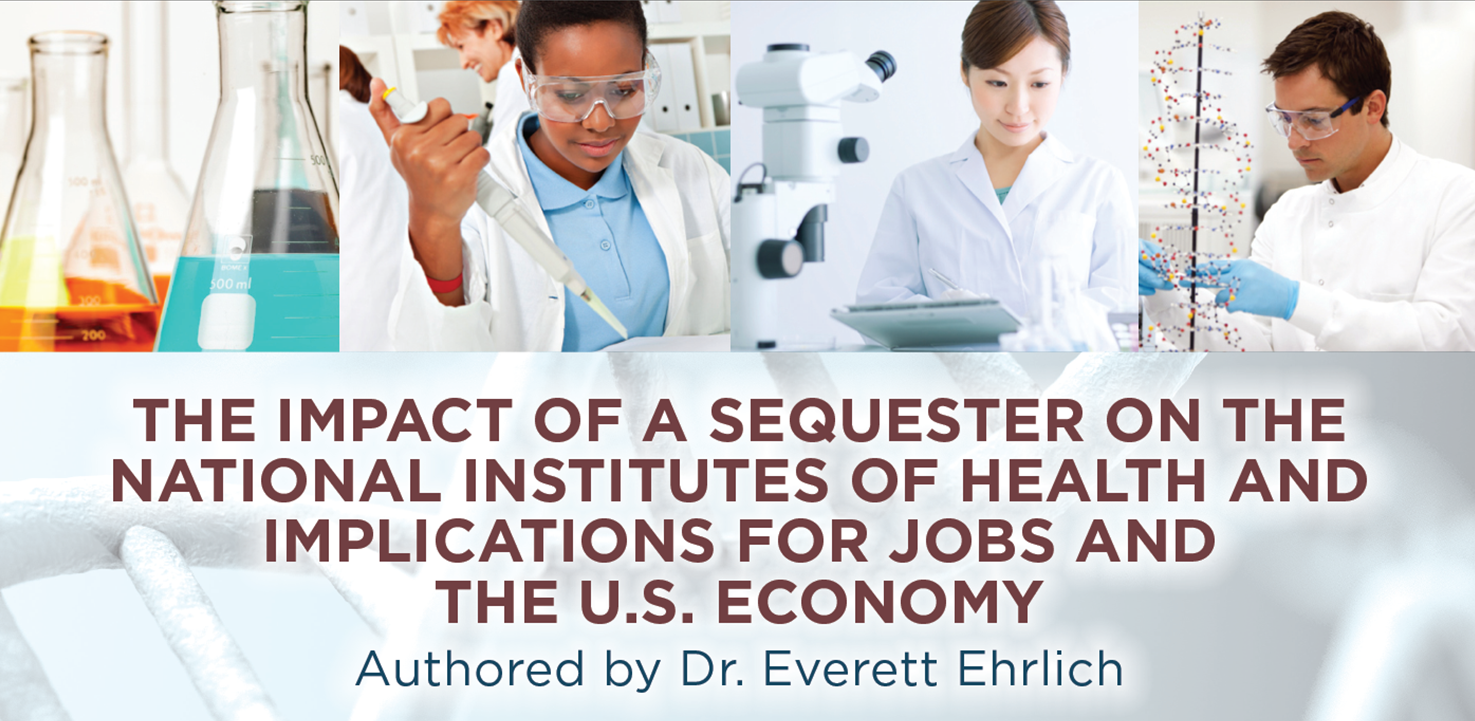
  • "The National Institutes of Health (NIH) supported more than 402,000 jobs and $57.8 billion in economic output nationwide in 2012 alone. If Congress fails to prevent the 5.1 percent automatic, across-the-board spending cuts slated for March 1, the nation's life sciences sector could lose 20,500 jobs and $3 billion in economic input."
Currently, only five cents of every U.S. health dollar goes to biomedical research; however, 1 in every 3 Americans is living with a deadly or debilitating disease for which there are no cures. The U.S. needs strong investment in biomedical research to deliver cures, save lives, and maintain our global competitiveness. There’s no time to waste.

Relevant links:
-- ACS CAN Report Highlights Critical Need for Sustained Funding for Cancer Research
-- Videocast of Jan. 14 SMRB meeting
-- The State of the FDA—February 2013
-- Report from United for Medical Research about the Economic Impact of Sequester on Life Sciences Sector
-- Sequestration Station
-- Time=Lives

Tuesday, February 12, 2013

Cutting-Edge Science, Collaboration, and Sustained Funding Needed to Get New Medicines from Lab to Patient

FasterCures and Friends of Cancer Research Host Capitol Hill Briefing

“While I can tell you there’s never been a more exciting time for science, I can also tell you there’s never been a more stressful time,” said Francis Collins, director of the National Institutes of Health (NIH), addressing the issue at hand – tightening fiscal resources that threaten the research and development ecosystem to fully deliver science’s full potential to improve health and well-being. This was the main topic of a Capitol Hill briefing co-hosted by FasterCures and Friends of Cancer Research.

Moderated by FasterCures Executive Director Margaret Anderson, Collins and other medical research leaders representing distinct sectors provided a glimpse into what it takes to turn a scientific discovery into a safe and effective therapy that will improve, and maybe even save, patients’ lives. More than 300 policy decision makers, advocates, and key legislative staffers participated.

“There is no one in this room who hasn’t been touched by disease, whether it’s yourself or a loved one,” said Ellen Sigal, chair and founder of Friends of Cancer Research, opening the discussion. “We cannot let the FDA or NIH become a victim of political polarization.” The discussion kicked off with video highlights from a viral campaign, Time=Lives, that featured images and stories of patients, families, researchers, and executives, reminding everyone in the room about what’s at stake.

Onyx CEO Anthony Coles explains impact
of public investment on drug development 
Underscoring the role of public investment in basic research by the NIH, N. Anthony Coles, president and CEO of Onyx Pharmaceuticals, noted that pharmaceutical companies depend solely on this research to understand biology and disease origins. “Companies like Onyx then take these findings, advance the research, and move it toward delivery to patients,” he said.

Improving and accelerating research and development requires all stakeholders in the medical research ecosystem to work together – including federal agencies, industry, academia, and patient groups. Collaboration – existing collaborative efforts, and the need for even more partnerships – was a resounding theme throughout the discussion.

Disease research organizations feel the excitement for an improved system. “This is the most robust pipeline we’ve seen. Now is not the time to step back from working together, but to do more,” said Deborah Brooks, co-founder of the Michael J. Fox Foundation for Parkinson’s Research.

“The FDA is the final common pathway to translating science to patients,” said Margaret Hamburg, commissioner of the U.S. Food and Drug Administration (FDA). “If the FDA is not fully funded and supported, the ecosystem will not function optimally. When we engage early with the scientific community, we’re able to cut five years off of the drug development process.”

Roy Jensen, director of the University of Kansas Cancer Center, is already seeing how limited resources are impacting research progress. “We’re not even funding a fraction of the best science. We’re starting to cut to the bone – scientists are having to close labs, they aren’t able to train the next generation… It’s fundamentally altering our infrastructure,” said Jensen.

The importance of supporting the next generation of brilliance and innovation weighs heavily on the minds at the NIH, and researchers are hopeful for the next group of young investigators. “It is very tough right now to be a grad student, or a post-doc. As they look at the landscape of this country, they wonder if there’s room for them,” Collins said.

Coles echoed Collins’ concern with a sobering concept about the future of scientific innovation: “What answers won’t we have in 10 years if we don’t fund this research?”

“The decisions we make today will have implications long into the future. Unlike delaying construction of a bridge that can be resumed in a few years, if we lose a generation of scientists, there’s no way to rebuild that human capital quickly,” said Mike Milken, founder of FasterCures and chairman of the Milken Institute. “We fully understand the need for overall budget restraint in Washington; but short-term cuts in bioscience only assure a less-healthy America down the road. Modest investments in prevention and cures today will help avoid the catastrophic costs of care tomorrow.”

* A video of this briefing is now available.


From L to R: Margaret Anderson, Roy Jensen, Deborah Brooks, Tony Coles, Ellen Sigal, Margaret Hamburg, Mike Milken, Francis Collins


Friday, December 7, 2012

Improving patient outcomes through technology

We hear a lot these days about how data sharing and collaboration have great potential to reduce the cost of healthcare and improve outcomes for patients – but who is actually doing it? What is at stake, what are the barriers, and what are potentially scalable solutions?

A Partnering for Cures panel focused on a case example of a patient-centric demonstration project within the ImproveCareNow Network, which includes 44 pediatric gastrointestinal care centers and more than 13,000 patients, and has succeeded in improving remission rates by sharing best practices among care teams across sites. Moderator Dominique Pahud of the Ewing Marion Kauffman Foundation introduced the goals, design, and participants leading the technology intervention.

The project features a collaboration among entrepreneurs, patients, physicians, designers, and researchers to provide a backbone for pediatric gastrointestinal care centers that delivers a full integration of technology-based solutions, including electronic health records, passive monitoring, and patient-recorded outcomes. The collaboration is employing a suite of technology interventions at eight different centers within the ImproveCareNow Network, representing 2,400 patients.

Each panelist discussed his or her contributions to the collaboration, with Richard Colletti of the University of Vermont School of Medicine introducing the operations and goals. Colletti highlighted that the remission rate of pediatric gastrointestinal patients increased from 50 percent to 75 percent since the establishment of the network in 2007, noting that “if we had done this with a new drug, it would be a drug that everyone would want to use.”

Peter Margolis of the University of Cincinnati School of Medicine discussed the founding of the network and the establishment of the revenue model, which relies on care centers paying to participate. He also highlighted the collaborative learning system of the network, which is based on a “steal shamelessly, share seamlessly” ethos.

Designers that were involved in creating the technology backbone also spoke on the panel, including John Chaffins of Lybba. Chaffins described the method that Lybba used to design apps, which was based on avatars that were used to solidify the concept of a “patient,” which he said “became a tool for thinking about the kind of design choices you are making … and establishing a common language” in the collaboration.

Anmol Madan of Ginger.io addressed his biggest challenges in being a health-focused entrepreneur, such as getting access to healthcare providers in order to understand their technology needs. He also commented that “the biggest value [of participating in the collaboration] was getting the validation we need to go from an interesting technology to a commercial product.”

Finally, John Wilbanks of the Ewing Marion Kauffman Foundation returned the conversation to the 10,000-foot level to discuss the challenges and opportunities for collaboration among multiple players in the biomedical space. As the developer of the intellectual property framework for the collaboration, he spoke of the need for an organizational structure that makes collaboration possible, including a “framework that allows for the creation of both private and public value.”

The panelists highlighted a range of organizational incentives for joining the project, and invited the audience to join the movement toward open, value-adding collaboration.

Tuesday, November 20, 2012

Releasing Unlocking IP: Principles for Responsible Negotiation

By Elizabeth West, Program Manager, FasterCures

Readers of the FasterCures blog are well aware of the importance of reducing cost, time, and inefficiency in the biomedical research system. One area consistently raised to us as having unnecessarily high transaction costs - both human and financial - is intellectual property (IP) negotiation.

We've long heard how IP can be a roadblock to innovation, but since it's a necessary and critical "cost" of doing business in drug development, we began to wonder if it might be possible to create an agreed-upon culture of responsibility in the practice of negotiating IP for medical research collaborations.

Last week we released Unlocking IP: Principles for Responsible Negotiation to serve as a set of guiding principles and points to consider when engaging in intellectual property negotiations involving biomedical R&D. The principles are a useful tool for all parties in biomedical research, in particular disease foundations, nonprofit disease groups, and philanthropists negotiating IP with academic, industrial, and nonprofit partners. The document includes principles for before, during, and after negotiations, for both new and seasoned organizations engaging in IP negotiations.

Some of the highlights include:
  • Do not let fear paralyze you…If the desired result [of a deal] is based on research impact as well as monetary returns, not doing the deal or slowing progress is a far bigger loss to the patient and the public than lower potential economic return.
  • Make sure you have the right people at the table at the right time…Think through which stakeholders are needed to  foster innovation, and only exclude a stakeholder group—especially nonprofits—after careful thought.
  • Build in “use it or lose it” requirements (interruption licenses)….If you have invested in the IP and the owner is not exercising the rights to use the invention and make it widely available, or if they are using it in a way that impedes progress, ensure you have a way to take it to a party where its value can be maximized.
The principles emerged from a small, expert-led working group convened by FasterCures in July 2012. In addition to developing the principles, the group came to some broader conclusions regarding the intellectual property ecosystem. In particular, it found that there is a fundamentally new landscape in biomedical research resulting from the emergence of venture philanthropy and patient advocacy groups. These groups tend to want to enhance the freedom to operate, versus the limiting model more prevalent in the current environment.  A key conclusion of the working group is that an IP management system is needed that addresses this emerging ecosystem, not reflects the current one. We welcome all of your thoughts on the fundamentals of a forward-looking IP system.

The Webinar – directly from the experts

On Nov. 16, we continued the conversation on IP and the principles through the TRAIN (The Research Acceleration and Innovation Network) Webinar series. The Webinar (available to view here), moderated by Margaret Anderson, was led by an expert panel of individuals with in-depth experience in intellectual property negotiation from a variety of viewpoints.

Maria Freire, of the Foundation for the NIH, laid out the main findings of the working group and gave a detailed overview of the principles themselves, as well as spoke of the increased sense of urgency and interest of many groups in deals that “move towards the goal.” Robert Cook-Deegan of Duke University’s Institute for Genome Sciences and Policy provided the audience with the broader landscape of intellectual property negotiation successes and controversies, as well as analyzed the elements of success through an in-depth case study of Cystic Fibrosis Foundation and the CFTR gene patent. David Lubitz, of Schaner&Lubitz, PLLC, which provides council for many disease foundations, gave a thorough overview of the viewpoint of disease foundations and venture philanthropy groups, including funding goals, trends, and useful IP tools, including  interruption licenses. Many of the questions during the Q&A period focused on the replicability of the Cystic Fibrosis Foundation model, which the panelists agreed would require a foundation with financial resources, technical expertise, and potential commercial partners.

More on IP at Partnering for Cures

We will have more on this topic at our annual conference, Partnering for Cures, in New York City, Nov. 28-30. The IP-focused panel, License to drive (innovation): IP strategies to support, not slow, progress, will explore the evolving IP law and procedures, the IP implications of the movement toward more precompetitive collaboration in biology, examples of responsible IP management practices, and how IP decisions can impact follow-on innovation and patient access. We invite you to join us there!