
|
Showing posts with label medical research. Show all posts
Showing posts with label medical research. Show all posts
Thursday, October 17, 2013
Look Who's Talking at Partnering for Cures 2013


 Partnering for Cures emphasized the urgency that time is lives... We have to be willing to approach [challenges] in a different way to get solutions."


Friday, June 28, 2013
Science, Cures and All the Stuff In Between
by Margaret Anderson
Reblogged from the Huffington Post
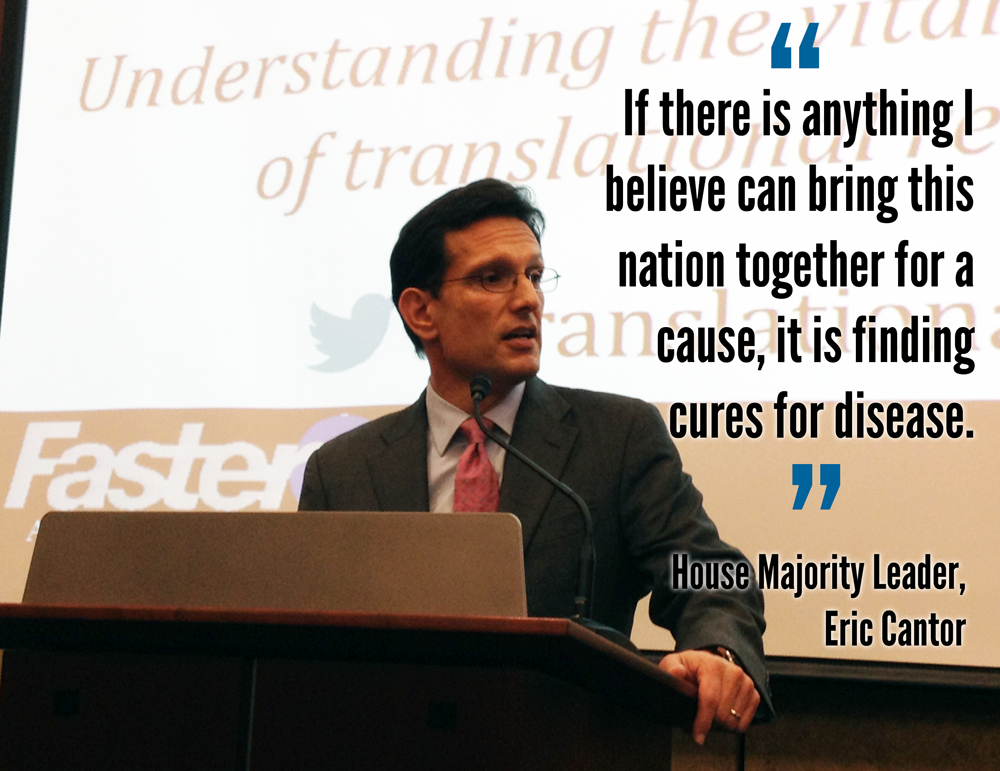
"If there is anything I believe can bring this nation together for a cause, it is finding cures for disease," said House Majority Leader Eric Cantor in his opening remarks. "We ought to be about research regardless of political leaning, because it is an investment that yields tangible returns for our country." In an environment where Congress is laser-focused on coming up with ways to spend dollars more wisely, his advice to advocates was to emphasize the following message to policymakers:
"NCATS is a unique new entity, purpose-built to solve this central paradox: that we know more than ever before about how the body works and what goes wrong in disease but lack the equivalent ability to fix it," said NCATS director Chris Austin. "We're designed to be perpendicular to how the rest of NIH works, and to focus not on what's different about disease but what is common." He went on to describe the institute as a biomedical equivalent to the Internet, focusing not on creating companies or products but on allowing people with ideas to share them in a more productive way, and de-risking investment by other sectors in this translational space.
Reblogged from the Huffington Post
The outlook for science has never been brighter -- we know more today than ever before about the molecular basis for thousands of diseases that impact millions of patients -- but the outlook for funding has also never been bleaker. With the National Institutes of Health losing a billion and a half dollars to the sequester, traditional investors retreating from early-stage life sciences, industry pipelines shrinking, and philanthropy unable to fill the gap, we are poised to leave a huge scientific opportunity on the table, namely our ability to get important new medicines out of the lab and to patients more quickly. And with millions of lives hanging in the balance, it's just not something Americans can afford to do.
FasterCures hosted over 100 congressional staffers, patient advocates, academics and drug developers at a Capitol Hill briefing about the importance of federal support for translational research, the phase of medical R&D between the birth of a basic scientific discovery made in the lab and when a pharmaceutical company tests out a potential new therapy with patients -- or, more plainly put, "the stuff in between" microscope and marketplace.
"If there is anything I believe can bring this nation together for a cause, it is finding cures for disease," said House Majority Leader Eric Cantor in his opening remarks. "We ought to be about research regardless of political leaning, because it is an investment that yields tangible returns for our country." In an environment where Congress is laser-focused on coming up with ways to spend dollars more wisely, his advice to advocates was to emphasize the following message to policymakers:
- It is good to be about cures. Disease touches us all, and as compassionate humans we should all care about improving and saving lives.
- It is good for the economy to invest in research. This leads to job creation and global competitiveness.
- It is a good way to bend the cost curve of health care. We have mounting deficits and debts, and we should prioritize the allocation of funds to areas like this that have the greatest impact.
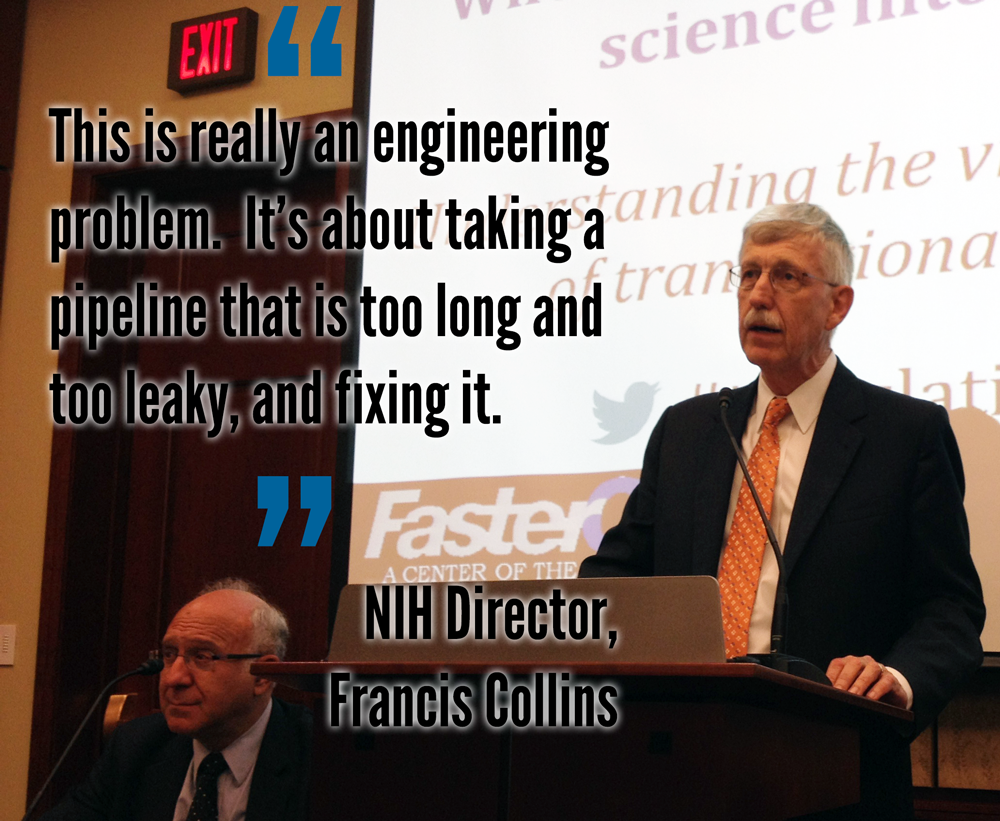
"This is really an engineering problem," said NIH Director Francis Collins. "It's about taking a pipeline that is too long and too leaky and fixing it." With each new therapy that comes to market taking up to 15 years to develop and costing over $1 billion, it's more challenging than one might think to successfully navigate the translational stage. There is great momentum in science, and we are poised to start solving several of these problems, particularly with the existence of the new National Center for Advancing Translational Science (NCATS) at NIH, but if we don't continue to invest, we risk losing not only time and lives but a significant driver of economic health.
"NCATS is a unique new entity, purpose-built to solve this central paradox: that we know more than ever before about how the body works and what goes wrong in disease but lack the equivalent ability to fix it," said NCATS director Chris Austin. "We're designed to be perpendicular to how the rest of NIH works, and to focus not on what's different about disease but what is common." He went on to describe the institute as a biomedical equivalent to the Internet, focusing not on creating companies or products but on allowing people with ideas to share them in a more productive way, and de-risking investment by other sectors in this translational space.
Both Collins and Austin said that there is no better time to pursue translational research. Today, we know the molecular causes behind 4,500 diseases, yet there are drugs available to treat just 250 of them.
"We are operating on hope, not hype," said Sharon Terry of the Genetic Alliance. "The network solutions that have overtaken other industries and streamlined them are finally starting to hit the biomedical research space, and we can't afford to lose momentum." She specifically referenced networked programs such as the Clinical and Translational Science Awards at NIH that are significantly advancing systems improvement in the translational phase and are primed, with the proper support, to foster more integrated research across communities. A new report released this week by the Institute of Medicine goes into more detail.
"Industry can't do it alone. ... Companies depend on basic science coming from the NIH," Simeon Taylor of Bristol-Myers Squibb said. He described how Big Pharma relies on the basic science discoveries made early on in the lab to develop drugs for patients who need them so desperately. Just last week, BMS, along with eight other companies, provided 58 compounds for an NCATS pilot program called Discovering New Therapeutic Uses for Existing Molecules, designed to develop partnerships between pharmaceutical companies and the biomedical research community to advance the development of therapeutics.
I had the privilege of moderating this discussion. The message that rose the top was clear: Getting a therapy from discovery to patients requires partnership and collaboration across all sectors in the medical research ecosystem: scientists, regulators, industry, investors, and, most importantly, the patients themselves. An effective R&D system is an efficient one, but reengineering the system in the way we know is possible requires support, and with funding at critically low levels, the ripple effects could be devastating. If we are to improve our odds for success for our patients and for our economy, there is no time to waste.
Thursday, May 30, 2013
Medical research investment: an opportunity for bipartisanship?
By Cecilia Arradaza, Director, Communications and Policy, FasterCures
May 29, 2013
 |
| Photo courtesy of the NIH |
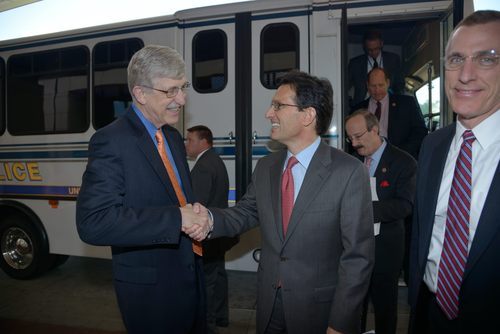
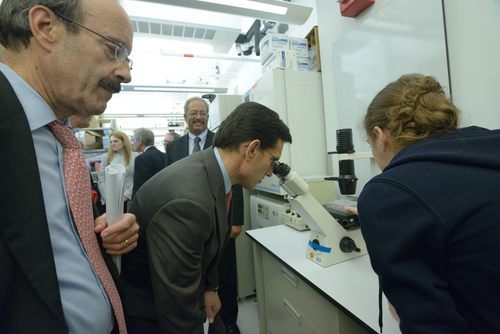
A few weeks ago, House Majority Leader Eric Cantor led a bipartisan group of members to the National Institutes of Health campus to learn more about their work, but also to discuss the future. Reps. Earl Blumenauer (D-OR), Michael Burgess (R-TX), Renee Ellmers (R-NC), Eliot Engel (D-NY), Chaka Fattah (D-PA), Andy Harris (R-MD), Tim Murphy (R-PA), and Ted Yoho (R-FL) joined the Majority Leader. Cheryl Jaeger, Megan Whittemore, and Matthew Zackon of Leader Cantor’s office and Karen Summar of Rep. Cathy McMorris Rodgers’s office also participated.
 |
| Photo courtesy of the NIH |
Seeing is believing – walking through the NIH Clinical Center, the crown jewel of our nation’s research framework, provides you not only with hope for the future but a real sense of optimism that science matters and that it can make a difference in our lifetime. So to see our Members of Congress carve out time to visit the NIH provides the medical research advocacy community with great hope we can reaffirm our commitment to the biosciences.
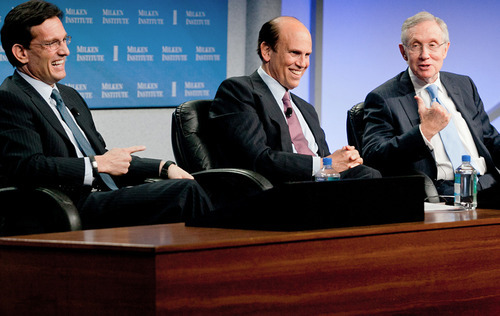
At the Milken Institute Global Conference, on a panel with Senate Majority Leader Harry Reid and FasterCures founder Michael Milken, Leader Cantor said that “[we] believe that science should be a priority.” He added that he “hopes when [the Congress] gets to the point where there are issues that seem insurmountable, let’s go ahead and try and practice doing things together so that we can get some things done.”
He then cited the creation of the National Center for Advancing Translational Sciences (NCATS), as one of the demonstrable results of him working closely with Leader Reid. “Harry, when you and I did NCATS, it was a great example I think of the ways that we can work together without a lot of fanfare and just practicing and putting points on the board, and maybe we can work our way towards larger goals after that.”
Cantor then alluded to the May 9th bipartisan trip to the NIH that he was organizing. “Not only will we spend a couple hours together one afternoon in Washington, but also perhaps learn something together we can practice trying to solve problems together,” he said.
During the panel discussion, Leader Reid concurred with Cantor’s statement on the critical importance of supporting science and noted that “if we’re going to make progress in some of the dreaded diseases we have, we have to step up as a federal government to do that. It’s going to take us working together to fund these programs so that our great scientists can continue doing what they know needs to be done. And we can’t do it on the cheap.”
Investing in our nation’s medical research infrastructure is an investment in our future.
From a dollars-and-cents vantage point, consider the economic payoff of the Human Genome Project: the U.S. government’s $4 billion investment in the Human Genome Project spurred an estimated $796 billion in economic growth from 2000-2010—a 141-fold return on investment, after adjusting for inflation.
And, we are living longer, more productive lives, due in large part to research advances that started at the NIH. For example, U.S. death rates from heart disease and stroke have fallen more than 60% in the last half-century.
The case for investing in science and medical research is clear. To punctuate this point, let’s turn to the cost of inaction. Well –
- talk to the brilliant PhD with bleak prospects for a career in science…
- talk to the employer who has lost his or her most productive and talented staffer because that person had to instead become a full-time caregiver…
- talk to the patient who just walked out of the doctor’s office after having been diagnosed with a debilitating disease for which there are no cures or meaningful treatment options…
Point punctuated.
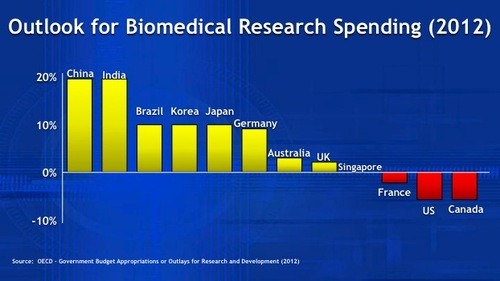
Now to further underscore, consider the global environment we’re in. At a time when other countries are doubling down on their biomedical research spending, the U.S. is cutting our investment (figure 1) in the industry that promises more jobs, greater productivity, and lives saved.
With all these compelling arguments to back us up, let’s remind our elected officials of what’s at stake, and get them to act on making medical research a national priority.
 |
| Figure 1 |
Related links:
- Photos from Leader Cantor’s personal Flickr of his trip to the NIH
- Global Conference 2013 panel discussion with Leader Reid, Leader Cantor, and Michael Milken
- The impact of NIH research

Monday, May 20, 2013
FasterCures Congratulates Marilyn Tavenner’s Confirmation as Medicare/Medicaid Chief
by Margaret Anderson, Executive Director, FasterCures
 |
| Photo courtesy of Yahoo News |
FasterCures congratulates Marilyn Tavenner for her confirmation as administrator of the Centers for Medicare and Medicaid Services (CMS), an $820 billion agency that oversees the bulk of federal healthcare spending and healthcare reform.
Tavenner is the first confirmed administrator for the agency in more than six years, backed by an overwhelming 91-7 vote in the Senate. Such demonstration of bipartisan support underscores the importance of having strong and sustained leadership of an agency that plays a vital role in determining the fate of the U.S. healthcare infrastructure.
CMS oversees Medicare, Medicaid, children’s health insurance, and implementation of many of the provisions of the Affordable Care Act. Decisions made by CMS impact not only the way we reimburse for costs associated with healthcare delivery, in so many ways, these decisions also determine what therapies patients can access today, and what therapies might move down the path from the laboratory bench to the patient’s bedside.
And that’s why at FasterCures, we’re particularly paying close attention to the role CMS and other payers could and should play in advancing innovation in research and development. We continue to work closely with all sectors of the medical research ecosystem to explore effective ways to engage payers into the R&D process whether it is through a discussion of what data sets are relevant to reimbursement decisions, or a broader conversation about the role that reimbursement will play on decisionmaking at biopharm companies as they decide therapeutic discovery pathways.
Tavenner has a long to-do list ahead and we commend her commitment to strengthening the agency to improve health outcomes for patients, make our health care delivery system more effective and efficient, and ensure the best possible therapies can be made available to the right patients at the exact time they need it.
We stand at the ready, Administrator Tavenner, to support you and CMS.
Tuesday, April 23, 2013

Tuesday, April 9, 2013
Imagine the possibilities if we could only read your mind…or at least map your brain
"Imagine if no family had to feel helpless
watching a loved one disappear behind the mask of Parkinson’s or struggle in
the grip of epilepsy. Imagine if we could reverse traumatic brain injury
or PTSD for our veterans who are coming home…,” said President Barack Obama
last week as he laid a grand, ambitious new government initiative to map the brain.

Obama said
he will ask Congress for $100 million in 2014 to support the BRAIN (Brain
Research through Advancing Innovative Neurotechnologies) initiative which
allows us to "better understand how we think and how we learn and how we
remember." Three government agencies will be involved: the National Institutes of Health, the Defense Advanced Research Projects Agency and the National Science Foundation.
“It's an
audacious, bold idea,” said Francis Collins, director of the NIH. "To understand how the
human brain works is about the most audacious scientific project you can
imagine," he said. "It's the most complicated structure in the known
universe."
In many ways, this initiative is
similar to the Human Genome Project which Collins led and completed in 2003, in
its vision and ambition. But, unlike the Human Genome Project, the BRAIN
initiative has not laid out its primary scientific goals. The lack of detail is worrying BRAIN skeptics
and advocates alike. Some
scientists were quick to question the motives behind this
initiative, noting that a lot of great research on the brain is already
underway.”
At a Q&A
segment following the President’s announcement, Collins said that these
details would be hammered out by a “dream team” of 15 scientists who will hold
their first meeting at the end of the month. This team is led by Cori Bargmann
of Rockefeller University and William Newsome of Stanford University, will be
charged with coming up with a plan, a time frame, specific goals and cost
estimates for future budgets.
Additionally, Obama addressed how this initiative can drive growth and create new job
opportunities. As the “rest of the world” is racing ahead in the quest for
innovation, he expressed concern that we will lose a new generation of
scientists because of uncertainty in research funding. We can’t afford to miss
these opportunities, he said.
The President called on companies,
research universities, foundations, and philanthropists to get involved.
What we took from
sitting in the room with the leaders and innovators in science and research as
the president spoke about the promise and potential of this new initiative, was
a broader message about the power and value of investing in science, and the
important role the federal government plays in ensuring scientific
breakthroughs can improve health. We took such enthusiasm and energy as
our cue to be more determined than ever to advance medical progress.
Upcoming Milestones
- As part of this planning process, input will be sought broadly from the scientific community, patient advocates, and the general public.
- The working group will be asked to produce an interim report by fall 2013 that will contain specific recommendations on high priority investments for Fiscal Year (FY) 2014.
- The final report will be delivered to the NIH Director in June 2014.

Key Resources:
- Remarks by the President on the BRAIN Initiative and American Innovation, April 2, 2013
- Video of Remarks by NIH Director Collins and the President, April 2, 2013
- Fact Sheet: BRAIN Initiative(Whitehouse.gov), April 2, 2013
- Video of Open for Questions with NIH Director Francis Collins(Whitehouse.gov), April 2, 2013
- WhiteHouse.Gov Blog: BRAIN Initiative Challenges Researchers to Unlock Mysteries of Human Mind, April 2, 2013
Friday, April 5, 2013
Time=Lives Story of the Week: Sienna Otto
“Sienna
can’t plant a flower, or skip, or twirl like a ballerina, or even hold her
mom’s hand when they walk. But since Sienna can’t plant a flower herself, we’re
going to do it for her…and in doing so, we’re going to save this little girl’s
life.”

Fibrodysplasia Ossificans Progressiva or F.O.P. is an extremely
rare genetic disorder where bone forms unexpectedly within muscle and other
soft tissue. Over time, this can cause joints to lock-up and leave them unable
to move. So, F.O.P. is often referred to as “stone man syndrome.”
Although two-year-old Sienna Otto was diagnosed with F.O.P. in
2012, neither Sienna nor her family have let this rare disorder affect their
positive outlook on life. Sienna loved to plant flowers outside with her
parents, however, F.O.P. makes it impossible for her to lean down to the ground
and kneel to the grass. So, with the help of their friend Natasha Lam O'Rourke and her Boston-based advertising agency, Connelly Partners, Sienna's family started Sienna’s Flower Garden (@CureSienna), a
virtual garden where each donation is recorded as a digital flower. All funds
go towards finding a cure for F.O.P. for children like Sienna.

According to the International Fibrodysplasia Ossificans
Progressiva Association (IFOPA), only 1 in 2 million people have
F.O.P., and there are less than 200 confirmed cases in the United States. Three
principle researchers and 15 fellows, students, and assistants make up the only
dedicated F.O.P. research lab in the country at the University of Pennsylvania.
Approximately $1.5 million dollars is spent on research each year - 75 percent
of which is comprised of family and patient fundraising and donations.
Unfortunately, F.O.P. is typically misdiagnosed by doctors
because it is so rare. Misdiagnosis of the disease leads to greater pain and
suffering of patients because unnecessary biopsies or other tests cause the
body to create more bone rather than regenerate tissue. To date, Sienna’s Flower Garden has raised more than $50,000
and continues to be an important resource for families and patients.
There are nearly 7,000 rare diseases affecting ~30 million
Americans, which means almost one in ten Americans is suffering from a rare
disease. Traditionally, rare disease research has been relatively siloed,
with limited communication between and across research organizations. However,
increasingly patients, their families, and the disease-specific organizations
that serve them are starting to work together towards the ultimate shared goal
of finding cures.
See more stories about
the power and promise of medical research to improve and save lives, and tell
us why it matters to you. Visit FasterCures’ Time=Lives campaign for more information.
Tuesday, April 2, 2013
Diving deeper into healthcare costs and breakthroughs
By Shawn Sullivan, Program Associate, FasterCures
Over the past few weeks, Washington has been consumed by conversations about the federal budget. Two recent events we attended, a Center for American Progress discussion and a Congressional Neuroscience Caucus briefing, aimed to cut through the rhetoric and focus on specific aspects of health funding – the affordability of healthcare and the relationship between mental illness and violence.
Over the past few weeks, Washington has been consumed by conversations about the federal budget. Two recent events we attended, a Center for American Progress discussion and a Congressional Neuroscience Caucus briefing, aimed to cut through the rhetoric and focus on specific aspects of health funding – the affordability of healthcare and the relationship between mental illness and violence.

The March 13 Center for American Progress
discussion, “The
High Price of Healthcare,” featured the journalist and author Steven
Brill, who wrote the recent TIME cover article “Bitter
Pill: Why Medical Bills Are Killing Us.” The conversation covered the
excessive number of healthcare services and exorbitant prices, as well as
reforms to control healthcare spending. “[Brill’s article] has changed the
entire conversation surrounding healthcare,” said panelist Giovanni Colella,
CEO and co-founder of Castlight Health. “It takes the issue to where the real
problem is. This is an industry where the entire incentive system is wrong.
We don’t know what we are paying, what we are buying, or what the outcomes
are relative to costs. That would never fly in any other industry. Imagine
paying for a Ferrari and getting a Toyota.”
While much of the debate about the Affordable Care Act has
focused on who is responsible for paying for healthcare, Brill pointed out
that there isn’t as much focus on the actual costs: “During the debate over
Obamacare, the questions being asked were about who pays for healthcare, when
the question should have been ‘why does it cost so much?’”
|
The March 18 Congressional
Neuroscience Caucus briefing examined the critical topic of mental
illness and violence, as well as the state of mental health services and
programs in the United States and scientific breakthroughs on the horizon that
can benefit the 60 million Americans who suffer from mental illness. “There
are two parallel conversations going on right now,” said Thomas R. Insel,
director, National Institute of
Mental Health. “One is about taking a fresh look at policy dealing with
gun violence due to the recent tragic events at Sandy Hook, and other places.
The other, due to things that have happened in only the last few months, is
about revolutions taking place in brain research. President Obama mentioned
mapping the brain in his recent State of the Union Address. But nobody is
bridging these two conversations. If we want to prevent more Sandy Hooks, we
have to do more about brain research.”
Elizabeth Childs, child and adolescent psychologist and
former commissioner of the Massachusetts Department of Mental Health,
emphasized the importance of funding mental health research in tough economic times: “I am well aware of
the challenges you face here in Washington to balance our budget, but there
are investments worth making. Underfunding of the National Institute of
Mental Health does not move us in the right direction. The reality is that
the lack of investment in mental health is far more costly in the long run,
including the increased burden that untreated mental illness has on the
nation’s education, public safety and corrections systems. And that is before
we factor in the incalculable human cost to families and our society.”
|
These conversations about the unique aspects and critical
impact of federal health funding are pivotal to our nation’s well-being and
productivity. As these conversations continue, we must focus on the real-world
impact of policy decisions on patients, families, and communities nationwide.
Friday, March 29, 2013
Time=Lives Story of the Week: Sarah and Adam Foye
Kids, DNA and Genetic Testing
Adam Foye, a New-Jersey sixth grader, has lived much of his life with weak muscles and uncertainty. Although his symptoms match most closely with the rare muscular disorder, Centronuclear Myopathy (CNM), his genes tell a different story. The 11-year-old’s tests show no issues with the genes that indicate CNM. Adam’s mother, Sarah, said in a recent TIME story, “it has taken a very long time to get no answers.”
 Check out Sarah’s Time=Lives story here.
Last year, Adam was one of three children to take part in a competition sponsored by Boston’s Charity Hospital called the Children’s Leadership Award for Reliable Interpretation and Appropriate Transmission of Your Genomic Information, otherwise known as CLARITY. More than 20 teams of international researchers competed to analyze Adam’s genetic sequence in comparison with someone who does not have CNM and translate the results into easily ready and interpretable information for patients, families, and doctors. The winning team, the Division of Clinical Genetics at Brigham and Women’s Hospital in Boston, took home $15,000 for their combined “analysis, clarity, and utility” in their reports.
Whole genome sequencing’s ability to provide key information for many currently unanswered medical questions holds great promise for the future of the healthcare industry overall. The process, which used to be priced in the billions, has dropped in cost and thus increased accessibility. However, questions still loom regarding what doctors and patients should do with their data, how that amount of data should be stored, and what guidelines need to be established to regulate the process. All of these issues need to be addressed before whole genome sequencing can be used with any regularity.
For the Foye family, it was discovered that Adam’s gene that encodes for the Titan protein is malfunctioning. Titan serves as spring in the muscle to help with contraction and expansion. Although there still is no cure for this problem, the Foyes are hopeful. “As my husband says,” notes Sarah in the TIME piece about the results of the competition, “this is not our final destination on our medical journey, but it’s an important milestone. Now we want to work toward a treatment.”
For more information on the CLARITY competition, watch: http://www.youtube.com/watch?v=T6SpWi0VJ0k&feature=youtu.be. And for further information about the potential uses of whole genome sequencing, read Gina Kolata's excellent t three-part series on the topic in the New York Times (links below).
Additional stories about the power and promise of medical research to find cures and save lives can be found on the Your Stories page of our Time=Lives campaign. Check out the site to find out what you can do to help make medical research a national priority. After all, we’ll all be patients someday.
Adam Foye, a New-Jersey sixth grader, has lived much of his life with weak muscles and uncertainty. Although his symptoms match most closely with the rare muscular disorder, Centronuclear Myopathy (CNM), his genes tell a different story. The 11-year-old’s tests show no issues with the genes that indicate CNM. Adam’s mother, Sarah, said in a recent TIME story, “it has taken a very long time to get no answers.”

Last year, Adam was one of three children to take part in a competition sponsored by Boston’s Charity Hospital called the Children’s Leadership Award for Reliable Interpretation and Appropriate Transmission of Your Genomic Information, otherwise known as CLARITY. More than 20 teams of international researchers competed to analyze Adam’s genetic sequence in comparison with someone who does not have CNM and translate the results into easily ready and interpretable information for patients, families, and doctors. The winning team, the Division of Clinical Genetics at Brigham and Women’s Hospital in Boston, took home $15,000 for their combined “analysis, clarity, and utility” in their reports.
Whole genome sequencing’s ability to provide key information for many currently unanswered medical questions holds great promise for the future of the healthcare industry overall. The process, which used to be priced in the billions, has dropped in cost and thus increased accessibility. However, questions still loom regarding what doctors and patients should do with their data, how that amount of data should be stored, and what guidelines need to be established to regulate the process. All of these issues need to be addressed before whole genome sequencing can be used with any regularity.
For the Foye family, it was discovered that Adam’s gene that encodes for the Titan protein is malfunctioning. Titan serves as spring in the muscle to help with contraction and expansion. Although there still is no cure for this problem, the Foyes are hopeful. “As my husband says,” notes Sarah in the TIME piece about the results of the competition, “this is not our final destination on our medical journey, but it’s an important milestone. Now we want to work toward a treatment.”
For more information on the CLARITY competition, watch: http://www.youtube.com/watch?v=T6SpWi0VJ0k&feature=youtu.be. And for further information about the potential uses of whole genome sequencing, read Gina Kolata's excellent t three-part series on the topic in the New York Times (links below).
Additional stories about the power and promise of medical research to find cures and save lives can be found on the Your Stories page of our Time=Lives campaign. Check out the site to find out what you can do to help make medical research a national priority. After all, we’ll all be patients someday.
Gina Kolata's Three-Part Series on Whole Genome Sequencing in the New York Times
- http://www.nytimes.com/2012/07/08/health/in-gene-sequencing-treatment-for-leukemia-glimpses-of-the-future.html?pagewanted=all&_r=0
- http://www.nytimes.com/2012/07/09/health/new-frontiers-of-cancer-treatment-bring-breathtaking-swings.html
- http://www.nytimes.com/2012/07/10/health/genetic-test-changes-game-in-cancer-prognosis.html
Monday, March 25, 2013
Tools of Engagement: Building patient-centered research networks
By Kristin Schneeman, Program Director, FasterCures
Engaging patients in the research process is more complex and exciting now than ever before. Patient-driven organizations are moving beyond simply creating patient registries or serving as a conduit to participants for clinical trials and are marshaling their forces in new and more comprehensive ways. In a FasterCures Webinar on March 20, participants heard about two exciting new models of such “patient-centered research networks,” the T1D (Type 1 Diabetes) Exchange and Registries for All Diseases.
 Dana Ball, CEO of the T1D Exchange, began by saying that after much due diligence about where the barriers and inefficiencies were in research and care for Type 1 patients, the Helmsley Charitable Trust set out to create an end-to-end solution to connect the R&D and healthcare enterprises with the patient resources necessary for all to succeed. What it has built in the T1D Exchange is a national network of 69 clinics treating 100,000 T1D patients, a 26,000-patient registry, and a 1,000-patient “living biobank” (i.e., samples are collected to answer specific questions). Integral to the network is Glu, a social network through which the Exchange is collecting valuable patient insight via surveys and discussions and which serves as a “real time access point for community-driven research using an innovative mobile platform.” With all these tools, the Exchange can share patient data, recruit patients, and collect samples quickly. Ball noted that absolutely critical to the success of the entire Exchange is a carefully constructed universal consent from patients.
The Exchange is meant to be self-sustaining. Ball noted that it provides products and services to academic and industry researchers and insisted that these are not “dirty words” for a nonprofit. “We think of ourselves as a high-quality CRO [contract research organization],” he said, with a unique trust relationship with the patient community. Another element of the sustainability model will be a new nonprofit company called Unitio, to be launched mid-year, which will license the platform the Exchange has created on reasonable terms to other disease groups. Ball noted that none of this would be possible without philanthropic support – no other single sector has the incentives to do this work. He was passionate about the need to educate philanthropists about how to invest for impact – the need for resources to hire good people, to create infrastructure that facilitates the whole enterprise but that others won’t create.
 Sharon Terry followed with a presentation about Registries for All Diseases (Reg4All), which recently won the Sanofi Collaborate/Activate challenge – a cross-disease, crowdsourced registry that promises to break down the silos between diseases and gather information from patients in a standardized way. Terry began by noting that while recruiting appropriate patients for trials is viewed as “finding a needle in a haystack,” in fact “the haystack is made of needles” – we are all potential trial participants and just need the engagement, education, and trust to get on the information highway.
Reg4All is an evolution of work that Terry and Genetic Alliance have been involved with for a number of years that continues to widen in scope and sophistication. It is built on the platform of DiseaseInfoSearch, a database that provides disease-specific information and resources about 13,000 different diseases. Reg4All is not a disease-specific registry but rather a platform for individuals to enter self-reported medical information via a “gamefied survey” – and eventually to import clinical data from electronic health records – fully identified and protected. The survey gathers information on both common data elements across diseases and on disease-specific data elements. Patients use very sophisticated privacy software to authorize access at a very granular level about what information different types of users can see, e.g. researchers recruiting for clinical studies.
Participants had many and excellent questions for the panelists, beginning with, “We’ve gone from having none to too many cost-effective open source registry choices. How do we choose…?” Terry commented that there are valid reasons for multiple registries to flourish, and that our goal should not be one solution but rather lots of interoperable solutions. In her view, the granular privacy settings that Reg4All offers are very important in getting there. She mentioned that Genetic Alliance will be hosting a series of nuts and bolts Webinars to instruct groups on topics such as how to leverage or build on an existing registry/biobank, and will provide Reg4All modules others can pick up and use.
Ball closed with another plea for philanthropists and philanthropies to support this kind of project, calling on them to be like Ben Franklin, building libraries instead of buying books for everyone.
Resources
Engaging patients in the research process is more complex and exciting now than ever before. Patient-driven organizations are moving beyond simply creating patient registries or serving as a conduit to participants for clinical trials and are marshaling their forces in new and more comprehensive ways. In a FasterCures Webinar on March 20, participants heard about two exciting new models of such “patient-centered research networks,” the T1D (Type 1 Diabetes) Exchange and Registries for All Diseases.

The Exchange is meant to be self-sustaining. Ball noted that it provides products and services to academic and industry researchers and insisted that these are not “dirty words” for a nonprofit. “We think of ourselves as a high-quality CRO [contract research organization],” he said, with a unique trust relationship with the patient community. Another element of the sustainability model will be a new nonprofit company called Unitio, to be launched mid-year, which will license the platform the Exchange has created on reasonable terms to other disease groups. Ball noted that none of this would be possible without philanthropic support – no other single sector has the incentives to do this work. He was passionate about the need to educate philanthropists about how to invest for impact – the need for resources to hire good people, to create infrastructure that facilitates the whole enterprise but that others won’t create.

Reg4All is an evolution of work that Terry and Genetic Alliance have been involved with for a number of years that continues to widen in scope and sophistication. It is built on the platform of DiseaseInfoSearch, a database that provides disease-specific information and resources about 13,000 different diseases. Reg4All is not a disease-specific registry but rather a platform for individuals to enter self-reported medical information via a “gamefied survey” – and eventually to import clinical data from electronic health records – fully identified and protected. The survey gathers information on both common data elements across diseases and on disease-specific data elements. Patients use very sophisticated privacy software to authorize access at a very granular level about what information different types of users can see, e.g. researchers recruiting for clinical studies.
Participants had many and excellent questions for the panelists, beginning with, “We’ve gone from having none to too many cost-effective open source registry choices. How do we choose…?” Terry commented that there are valid reasons for multiple registries to flourish, and that our goal should not be one solution but rather lots of interoperable solutions. In her view, the granular privacy settings that Reg4All offers are very important in getting there. She mentioned that Genetic Alliance will be hosting a series of nuts and bolts Webinars to instruct groups on topics such as how to leverage or build on an existing registry/biobank, and will provide Reg4All modules others can pick up and use.
Ball closed with another plea for philanthropists and philanthropies to support this kind of project, calling on them to be like Ben Franklin, building libraries instead of buying books for everyone.
Resources
- View the Webinar slides
- Watch an archive of the Webinar
- Innovator: Sharon Terry's Global Database for Disease Research
 |
| http://train.fastercures.org/ |
Technology Entrepreneurs Unite at SXSWi
By Lauren Fliegelman, FasterCures Intern

Earlier this month the city of Austin, Texas played host to the best and brightest technology entrepreneurs at the interactive portion (SXSWi) of the South by Southwest (SXSW) 2013 conference and festival. A magnet for startup companies looking to make an impact, it brought together a wide range of breakthrough IT innovations – some of which have the potential to make waves in the healthcare and medical research industries.
FasterCures was not there in person, but we watched the events unfold from afar and were quite enthused by some of the things we saw.
Trends
 Trending topics at this year’s event included the potential of 3D printing to revolutionize U.S. manufacturing and product design. Already, examples of the use of 3D printing can be seen in the orthopedic industry. Earlier this month, Oxford Performance Materials demonstrated how this technology is able to replace 75 percent of a patient's skull, with the approval of U.S. regulators, using 3D-printed implants that take the place of bone damaged by disease or trauma. Several discussions at SXSWi addressed this technology and explored its continued development, practical applications, and safety implications.
 Additionally, the “Quantified Self” movement – a trend towards collecting health data from our bodies in real time and tracking its impact on our overall wellness – was a highlight of the week. The case for collecting big data has been made in previous years at SXSWi, however, more advanced wearable technology has since been developed allowing each and every one of us to record and measure our everyday bodily functions – from fitness impact to sleep quality to metabolic performance – allowing for greater analysis and insight.
Technologies of note
The newly formed Neurotrack was the winning healthcare startup at the event. Neurotrack’s work towards earlier Alzheimer’s detection is rooted in 25-year-old research from neuroscientists at UC San Diego. Its test can now identify those at risk for Alzheimer’s disease six years before the onset of symptoms, which is traditionally when an initial diagnosis is made. CEO Elli Kaplan said that 100 percent of those who scored lower than 50 percent on the test went on to develop Alzheimer’s disease.
Higi, a medical screening startup, had its own lounge at the event where Higi Stations, which measure different aspects of your health and give you a score out of 999, were readily available for use. A higher score means better physical, mental, and social health. The Higi philosophy is that many of the US’s major health ailments such as obesity and diabetes could be cured through prevention. According to the company, if you know more, you’re more likely to do more. Armed with their score, people have the ability to make significant changes in their lives.
Other cool stuff

For more information on SXSWi 2013, and to see a list of guest speakers and participants, visit http://sxsw.com/interactive.
Friday, March 22, 2013
Time=Lives Story of the Week: Jessica Foley
Encouraging the next generation of scientists
“What motivates me is working in a field where every day it's changing, it’s challenging, and it’s exciting.”
Meet Jessica Foley. She’s the Scientific Director at the Focused Ultrasound Foundation (FUSF) and a long-time advocate for greater use of the focused ultrasound, a revolutionary technology that allows for the treatment of numerous diseases without the danger of invasive surgery or a lengthy recovery time.
 Watch Jessica’s story here.
Currently, MR-guided focused ultrasound surgery has been approved by the U.S. Food and Drug Administration (FDA) for the treatment of uterine fibroids, and has obtained CE-mark approval in Europe for uterine fibroids and pain from bone metastases. However, the possibilities for this technology are countless - with ongoing clinical trials for breast tumors and brain tumors, and plans to begin additional research into it's impact on several other kinds of tumors, stroke, and epilepsy.
For over 12 years, Jessica has had a rich career as a scientist and researcher in this novel field. Before joining FUSF, she worked with InSightec and Medtronic, and also served as a 2011-2012 AAAS Science and Technology Policy Fellow at the National Science Foundation.
We met up with Jessica at last year’s Celebration of Science to talk about what she envisions for future generations of scientists and researchers and the challenges they may face with today’s economic shortcomings. She emphasized the need to elevate the role of science in our society so we can attract and engage tomorrow's innovators.
 "Years ago [the public] seemed to get it," said Jessica, who holds a Bachelor’s in Biomedical Engineering from Duke University and a PhD in Bioengineering (emphasis in focused ultrasound) from the University of Washington. "And maybe not everyone gets it now, but I hope that through all sorts of projects we're trying to work on we can get to that point again where kids want to grow up and be scientists and engineers."
To learn more about the Focused Ultrasound Foundation visit http://www.fusfoundation.org.
 And make sure to check out the TIME=LIVES campaign for more stories about the power and promise of medical research, and to help spread the message that research matters and needs to be a national priority.
“What motivates me is working in a field where every day it's changing, it’s challenging, and it’s exciting.”
Meet Jessica Foley. She’s the Scientific Director at the Focused Ultrasound Foundation (FUSF) and a long-time advocate for greater use of the focused ultrasound, a revolutionary technology that allows for the treatment of numerous diseases without the danger of invasive surgery or a lengthy recovery time.
Currently, MR-guided focused ultrasound surgery has been approved by the U.S. Food and Drug Administration (FDA) for the treatment of uterine fibroids, and has obtained CE-mark approval in Europe for uterine fibroids and pain from bone metastases. However, the possibilities for this technology are countless - with ongoing clinical trials for breast tumors and brain tumors, and plans to begin additional research into it's impact on several other kinds of tumors, stroke, and epilepsy.
For over 12 years, Jessica has had a rich career as a scientist and researcher in this novel field. Before joining FUSF, she worked with InSightec and Medtronic, and also served as a 2011-2012 AAAS Science and Technology Policy Fellow at the National Science Foundation.
We met up with Jessica at last year’s Celebration of Science to talk about what she envisions for future generations of scientists and researchers and the challenges they may face with today’s economic shortcomings. She emphasized the need to elevate the role of science in our society so we can attract and engage tomorrow's innovators.

To learn more about the Focused Ultrasound Foundation visit http://www.fusfoundation.org.

Wednesday, March 20, 2013
The long-term effects of sequestration on medical research
“I worry about the treatments that we’re not going to discover as a result of these cuts. What does this mean downstream; what does it mean in terms of the unmet needs of patients who have diseases with no treatments or cures? The NIH investment is a very powerful driver to this entire enterprise.”
- Margaret Anderson

“We’re going to lose an entire generation of scientists moving forward,” Marquis cautioned. “We’re already not seeing kids pursuing scientific careers because there is no future for them.”
Though optimistic about the possibility to reverse this alarming trajectory, Anderson and Marquis warned that medical science is an area in which the United States cannot afford to fall behind. They emphasized the outsized impact that investments in research have on both human health and the health of our economy, and noted that it is hard to compare these types of cuts with others.
“This is a powerful investment in the future - for patients, for the economy, for jobs, for industry. I don’t think it’s the same as cutting other programs,” Anderson said. Marquis agreed and offered a bit of hopefulness, “I think we see from both Republican and Democrats…there is huge support for NIH’s biomedical research, primarily because of the human health and economic benefits that we reap from our investment.”
So if Congress understands that medical research is vital to the future of our country, what can be done to ensure we don’t lose our preeminence in the life sciences?
Anderson thinks there’s hope for the NIH to avoid budget-desolation. “I’m an optimist. I think that people need to speak their mind to their members of Congress about how they feel about this investment.” She also spoke about the power of team science and cross-sector collaboration in moving promising research from lab to patient faster.
Just this year, NIH will be forced to reduce its spending by $1.6 billion, significantly slashing the United States’ ability to fund basic scientific research. Yes, that’s billion with a capital B. Devastating to the medical research community – and more importantly, to the hundreds of thousands of patients suffering from diseases for which there are no cures and few treatment options – does not begin to describe the impact of sequestration.
What Can Be Done?
- Contact your Members of Congress and let them know that further cuts to the NIH and FDA will set us back on the path to new therapies and cures for disease, jeopardize our economic competiveness, and result in job loss in communities throughout our country. Share with them why a strong investment in medical research is important to you, your family, and your community.
- Submit your story about why medical research and protecting funding for new research matters to Time=Lives.
- Attend the Rally for Medical Research on April 8th here in Washington, DC. Even if you can't attend, check out their site for more way to get involved!
Tuesday, March 19, 2013
Building a culture of participation in research
By LaTese Briggs Program Analyst at FasterCures
“I have been waiting 174 days to say this: 'Good Morning America.' "
Good Morning America anchor, Robin Roberts, made her
triumphant and long awaited return to the talkshow last month after a five month
recovery from a bone marrow transplant to treat myelodysplastic
syndrome (MDS). The show and her fans have been celebrating and supporting
Roberts’ through her courageous fight and recovery. An emotional Roberts’
thanked her fans, colleagues, and doctors for helping her through her battle
with the disease, but she also took the time to thank all of the courageous
people that participate in clinical trials.
 According to studies conducted by CenterWatch, 94% of Americans recognize the
importance of participating in clinical research in order to assist in the
advancement of medical science; however, 75% of Americans state they have
little to no knowledge about how clinical trials work and the participation
process. This staggering statistic highlights the need to raise clinical trial
awareness among the general public. Even small efforts like a simple thank you
to clinical trial participants from a beloved morning show anchor, can have a
major impact on achieving this goal. Thus involvement from the media and high
profile individuals to illuminate the importance of clinical trials can be used
as a powerful tool to educate the public on the link between improvements in
healthcare and clinical research.
According to studies conducted by CenterWatch, 94% of Americans recognize the
importance of participating in clinical research in order to assist in the
advancement of medical science; however, 75% of Americans state they have
little to no knowledge about how clinical trials work and the participation
process. This staggering statistic highlights the need to raise clinical trial
awareness among the general public. Even small efforts like a simple thank you
to clinical trial participants from a beloved morning show anchor, can have a
major impact on achieving this goal. Thus involvement from the media and high
profile individuals to illuminate the importance of clinical trials can be used
as a powerful tool to educate the public on the link between improvements in
healthcare and clinical research.
Educating patients and non-patients alike has become infinitely easier with the advent of online registries and databases. Sites like clinicaltrials.gov help doctors, patients, friends, and family members find clinical trials soon to be conducted in their area, their specific disease or a find a call for a person with a particular medical history.
The involvement of patient advocacy groups has also proven to be an effective way to increase clinical trial awareness and patient enrollment. A good example of this is the Love/Avon Army of Women collaboration between the Dr. Susan Love Research Foundation, the Avon Foundation, and the American Association of Cancer Research. The goal of this initiative is to recruit one million women willing to donate time, biospecimens and data to breast cancer research. To date, the organization has recruited nearly 400,000 women.
In addition, the use of outreach workers to educate patients about clinical trials can also potentially have a huge impact. These workers would not only make patients aware of clinical trials, but also work to address concerns and misconceptions about clinical trials that some may have. Common concerns include fear of experimentation, logistical concerns related to costs, insurance coverage, travel, missing work and/or time with family. Some common misconceptions are that clinical trials are last-resort efforts and one should only participate when all other approved treatments have failed, placebo treatment means that no treatment will be provided, and the assumption that intervention or treatment in the clinical trial is more invasive than standard treatment.
“I have been waiting 174 days to say this: 'Good Morning America.' "
 |
IDA MAE ASTUTE/ABC |
“The standard treatments of today are developing because
patients before you participated in clinical trials, and in a certain sense
it’s our obligation as physicians and the patients of today to develop the
standards of care for the patients of tomorrow.”
By participating in clinical research studies, these giving
volunteers play a key role in improving the standard of care for themselves and
future patients. Clinical trials are critical to bringing new drugs and
interventions to patients in need. In a recent editorial
by Francis Collins, Director of the National Institute of Health (NIH), he
explains that the wealth of discoveries related to the genetic and
environmental causes of disease, have led scientists to numerous new targets
for drug development; however, the rate at which new drugs and other
therapeutics are reaching patients has not increased proportionately. A key
impediment to the translation of these discoveries to new treatments is the
poor participation rate of Americans in clinical trials. This problem has been
well-demonstrated in cancer where according to the NIH, only 3% of adults with
cancer are participating in clinical trials.

Educating patients and non-patients alike has become infinitely easier with the advent of online registries and databases. Sites like clinicaltrials.gov help doctors, patients, friends, and family members find clinical trials soon to be conducted in their area, their specific disease or a find a call for a person with a particular medical history.
The involvement of patient advocacy groups has also proven to be an effective way to increase clinical trial awareness and patient enrollment. A good example of this is the Love/Avon Army of Women collaboration between the Dr. Susan Love Research Foundation, the Avon Foundation, and the American Association of Cancer Research. The goal of this initiative is to recruit one million women willing to donate time, biospecimens and data to breast cancer research. To date, the organization has recruited nearly 400,000 women.
In addition, the use of outreach workers to educate patients about clinical trials can also potentially have a huge impact. These workers would not only make patients aware of clinical trials, but also work to address concerns and misconceptions about clinical trials that some may have. Common concerns include fear of experimentation, logistical concerns related to costs, insurance coverage, travel, missing work and/or time with family. Some common misconceptions are that clinical trials are last-resort efforts and one should only participate when all other approved treatments have failed, placebo treatment means that no treatment will be provided, and the assumption that intervention or treatment in the clinical trial is more invasive than standard treatment.
Clinical trials are truly the crux of drug development and
medical innovation. Most trials evaluate new treatment options for safety and
efficacy before making them commercially available; however, clinical trials
are also used to understand the root cause of disease, improve disease
detection, and compare commercially available drugs to determine which are more
effective in certain patients.
By raising awareness and educating the public about the power of clinical trials, we will be able to move research forward faster such that the many patients plagued by one disease or another will be able receive new and innovative medical solutions that hopefully exceed the current standard of care.
By raising awareness and educating the public about the power of clinical trials, we will be able to move research forward faster such that the many patients plagued by one disease or another will be able receive new and innovative medical solutions that hopefully exceed the current standard of care.
To find out more
information about clinical trials and how you can get involved, check out these
links:
-- http://clinicaltrials.gov/
FasterCures' Patients Helping Doctors (PHD) Program
The Patients Helping Doctors (PHD) program anchors everything we do at FasterCures. In fighting disease, patience is not a virtue—patients are. Through PHD, we are building a culture of participation in research where patients and healthy volunteers understand the fundamental value they bring to clinical research. We focus our efforts on unlocking patient information—medical records and biological material such as tissue, blood, and DNA—and making these available to clinical researchers in a meaningful way. Learn more here.
FasterCures' Patients Helping Doctors (PHD) Program
The Patients Helping Doctors (PHD) program anchors everything we do at FasterCures. In fighting disease, patience is not a virtue—patients are. Through PHD, we are building a culture of participation in research where patients and healthy volunteers understand the fundamental value they bring to clinical research. We focus our efforts on unlocking patient information—medical records and biological material such as tissue, blood, and DNA—and making these available to clinical researchers in a meaningful way. Learn more here.
Subscribe to:
Posts (Atom)
